How to play
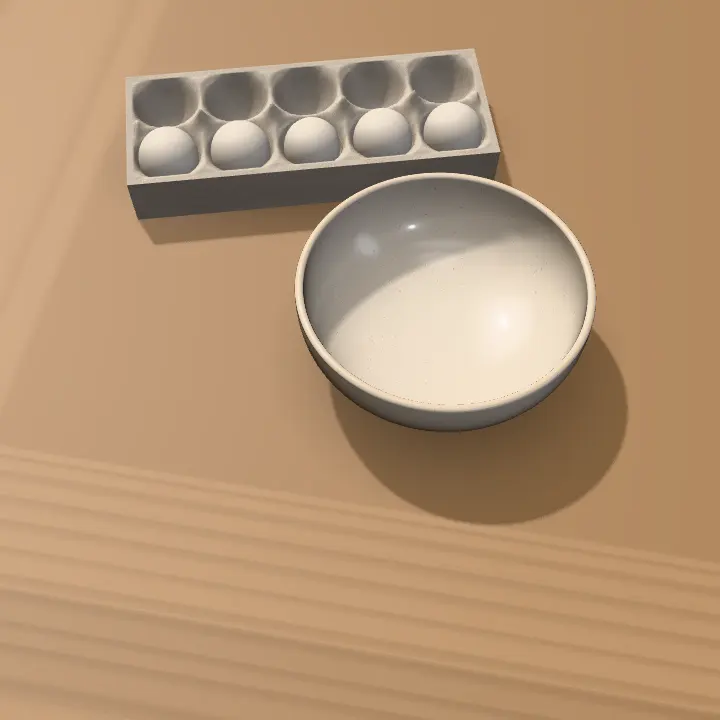
On a phone use one finger; on a computer hold the left mouse button and drag. A kitchen counter, a bowl and an egg tray appear in 3D. Crack the five eggs from the tray into the bowl, one at a time.
- Press Start on the board and the game fills the screen and picks up the first egg. The × at the top right (Esc on a computer, Back on a phone) ends the round without a score and returns to the page.
- Tap: press and push down, and the egg follows your finger onto the counter. How fast you push is how hard it hits. You can also flick down and let go; the egg keeps that speed.
- Too soft and the shell only dents. Lift and tap again, but each extra tap costs a little. A good tap makes a clean crack around the middle; too hard and the shell breaks around the crack or gets crushed.
- Open: once cracked, the egg moves over the bowl. Spread two fingers, or drag one finger (or the mouse) sideways, to pull the crack open. The white runs out first, and the yolk drops through the gap when the shell is about half open.
- Watch the Opening speed bar and open slowly and evenly. Green is smooth, yellow is careful, and red is the speed that breaks the yolk. Let go to pause; press again to keep opening.
- After five eggs you see the bowl from above with your score. That view becomes the result image. Under the board, Play again starts a new round right away, Share result opens the share sheet, and Close goes to the result panel on the page.
Scoring
Each egg starts at 100 and loses the points below (never under 0). Five eggs make 500. Scores count to one decimal place. After each egg, the board shows what cost points and your tap force and opening speed.
- Each shell bit in the bowl: −8
- A broken yolk: −35 (double yolk: −20 per yolk)
- Each extra tap after the first: −3
- Tap force: 0 to 6. No loss within ±6% of the exact force (100%), a little more the further off. If the shell broke around the crack: −6
- Opening speed: 0 to 8. No loss if you open evenly over a bit more than a second; a little more the faster you go. A broken yolk: −8
- Opening so slowly that the white strings out: −3
- The labels (500 Perfect, 490+ Chef level, 465+ Very clean, 430+ Mostly clean, 350+ A bit messy) are this site’s own, for fun. A first try easily scores in the 400s, but 500 needs all five eggs exactly right.
Tap force and the crack (game rules)
The game turns the speed at impact into force using the egg’s shell thickness and weight. The same speed hits a thick shell softer and a heavy jumbo egg a bit harder. Each egg’s size, shell and freshness appear under the board.
- Tap force is shown as a percentage of the exact force (100%). On the bar, the dark green slot is the exact force (94–106%) and the light green is the range that still cracks cleanly.
- Too soft (below about half): the shell only dents. A dented spot is a little weaker on the next tap, and soft taps add up to a crack eventually, but a jagged one.
- Good (light green): a clean crack around the middle. The range is wide, so it is easy to crack on the first try, but you lose a little the further you are from the dark green slot.
- Hard (yellow): the shell breaks around the crack and bits fall into the bowl as you open it.
- Far too hard (red): the shell is crushed, many bits fall in, and at the top end the yolk bursts too.
- How many bits a broken crack or extra taps produce is fixed for each egg. The same hands always get the same score.
Opening speed and the yolk (game rules)
The game treats the opening from 0 (closed) to 1 (fully open) and measures how much you open per second. It uses the times of your finger movements, so a slow screen gives the same result for the same motion.
- Opening speed is shown as a percentage of what the yolk can take (100%). The yolk passes through the gap when the shell is about half open (0.42 to 0.76). Above 100% at that moment, it catches on the shell edge and breaks. The short mark on the bar is the fastest moment for that egg.
- A fresh egg has a tougher yolk membrane and survives a little more speed; older eggs are weaker. In a double-yolk egg the two yolks pass one after the other and crowd the gap, so they are a little weaker.
- Yanking it open (4.5 times the speed of opening fully in one second) flicks shell bits into the bowl.
- Opening very slowly (more than 4.5 seconds after the white starts to run) makes the white string out, which costs points.
Stages (10 levels)
Choose Stages in the mode switch above to open the stage board. Each stage has its own set of eggs (how many, which kind) and rules, and your total (100 points per egg) earns 0 to 3 stars. Stage 1 is always open; at least 1 star in a stage opens the next one. Stage results stay in this browser and are not ranked.
- 1. Warm-up: three ordinary eggs.
- 2. Usual five: five ordinary eggs, each a little different in size and shell.
- 3. Thin shells: a light tap cracks them, but a tap that suits an ordinary egg breaks the shell around the crack.
- 4. Brick shells: thick shells that need a faster tap than usual.
- 5. Quail eggs: small, with a tough inner membrane. While it holds, the gap opens less than your finger moves; pull fast there and it tears raggedly and drags a shell bit in.
- 6. Double trouble: three double-yolk eggs. Each broken yolk costs 20 points.
- 7. Fridge relics: five old eggs. The yolk breaks at a lower opening speed and the white spreads wide.
- 8. Duck eggs: four eggs, bigger than a hen’s egg, with a stronger shell.
- 9. 25-sec dash: five eggs in 25 seconds (from picking up the first egg to opening the last). When time runs out the round ends and uncracked eggs score 0.
- 10. Ostrich egg: it takes three firm taps to crack (those three cost nothing), and one hard tap breaks it. The white and the giant yolk nearly fill the bowl.
- Star thresholds are set so that a decent player gets 3 stars on stage 1 about four times in ten, and mostly 1 or 2 stars after that. The result shows how many points you were short of the next star.
Cracking eggs cleanly in a real kitchen
These are tips cooks commonly give. The game follows them and cracks the egg on a flat counter.
- Use a flat surface, not the bowl rim: a sharp rim tends to push the shell inward and shatter it into small pieces. Tapping on a flat counter is commonly recommended because it makes a wider, single crack with fewer bits.
- One good tap: many soft taps make a jagged crack, and one very hard tap crushes the shell and pushes your fingers into the white.
- Use a small bowl first: when you need several eggs, crack each into a small bowl, check it, then add it to the big bowl. A shell bit or a bad egg will not spoil the whole batch.
- Scoop shell out with the shell: a spoon or a fingertip slides around the bit. The sharp edge of a broken half shell cuts through the white and scoops the bit out easily.
- One-handed cracking: hold the egg in your fingertips, thumb and index finger on one side, middle and ring fingers on the other. Tap it on a flat surface, then over the bowl lift your thumb while pulling the lower fingers down, so the shell opens like a hinge. It takes practice; two hands drop less shell at first.
- Wash your hands after handling raw eggs. Salmonella can be on the shell.
Fresh eggs and old eggs
There is an air cell inside the blunt end of an egg. Over time, moisture and carbon dioxide escape through tiny pores in the shell and the air cell grows. That is why older eggs float more easily.
- The float test: in cold water, a fresh egg sinks and lies on its side, an older one tilts or stands on end, and an old egg floats. Floating alone does not prove an egg is spoiled, so crack it separately and throw it out if it smells or looks off.
- When you crack it: a fresh egg has a round, high yolk, and the thick white stays close around it. As eggs age, the white thins and spreads, the yolk flattens, and the membrane around the yolk weakens so it breaks more easily. In the game, older eggs break their yolks more easily too.
- Storage: keep eggs in their carton on an inside shelf of the fridge. Storing them pointed end down (air cell up) is commonly recommended. The door warms up every time it opens.
- Double yolks: two yolks formed at almost the same time end up in one shell. They are known to be more common in large eggs from young hens that have just started laying. In the game, one turns up in the daily eggs now and then.
Quail, duck and ostrich eggs
The force and speed values in the game are set for play. Real eggs are roughly like this.
- Quail eggs weigh around 10 g and have speckled shells. The membrane inside the shell is tough, so many people snip the top off with a knife or quail egg scissors.
- Duck eggs are bigger than hen’s eggs and tend to have thicker shells. The shell can be white or pale blue-green, depending on the breed.
- Ostrich eggs are the largest eggs of any living bird: around 15 cm long and around 1.4 kg, more than 20 hen’s eggs. The shell is around 2 mm thick, so they are often opened with a tool that drills or cuts it.
Should eggs be at room temperature?
It depends on the dish.
- Baking: room-temperature eggs blend more evenly into butter and sugar, and whites whip up better, so many recipes ask for them.
- Separating whites and yolks: cold eggs have firmer yolks that break less, so they separate more easily. Let them warm up after separating.
- Warming up quickly: put the eggs, still in their shells, in warm (not hot) water for 5 to 10 minutes.
- Do not leave them out long: water can condense on a cold shell and help bacteria get in, so the USDA advises not leaving refrigerated eggs out for more than 2 hours.
Daily eggs and the leaderboard
The daily eggs are set by this device’s date, and everyone with the same date gets the same five eggs anywhere in the world. Size, shell thickness and freshness change every day, and about one day in five includes a double yolk. New eggs arrive at midnight.
After cracking the daily eggs, type a nickname under Leaderboard in the result panel to post your score. Higher scores rank first, and ties go to whoever submitted first. The weekly board resets every Monday at 00:00 Korea time (Sunday 15:00 UTC); the all-time board keeps growing.
- Score range: 1 to 500 (one decimal place).
- Timing check: picking up the egg, moving it over the bowl and pouring it take a fixed 2 seconds per egg with no input. The server checks that at least 9 seconds really passed since the round started. Each round can be submitted once, within 15 minutes of starting.
- Practice eggs are random and saved only to your own history, not the leaderboard.
- Nickname: 1–12 characters using Korean (Hangul), Latin letters (including Spanish á, ñ, ü), Japanese (kana/kanji), digits, spaces, _ or -. Profanity, slurs, names impersonating the site or its staff, and web addresses are not allowed.
- #number: the first time you submit, a random identifier is created in this browser and a four-digit number is derived from it, so you appear as Alex#4821. Players with the same name are told apart by the number, and changing your name in this browser also renames the scores you already submitted. Clearing browser data or submitting from another device or browser gives you a different number.
- Public, and removal: names, scores and dates on the leaderboard are visible to everyone. To prevent abuse we also store a one-way hash of your IP address, which is deleted after 30 days. To have an entry removed, contact us at the address in the privacy policy.
- You can submit up to 30 times per hour from the same connection. Scores found to be made by cheating may be removed.
FAQ
What is a good score?
There is no official standard. Careful play mostly lands between 430 and 490. With each tap close to 100% and each egg opened evenly over a bit more than a second, you pass 495, and five exact eggs make 500.
Why do my yolks keep breaking?
The yolk passes through the gap when the shell is half open, and it breaks if you are going fast at that moment. Open at one slow speed from start to finish. Older eggs and double yolks are weaker, so go slower with them.
When does shell get into the bowl?
When a hard tap breaks the shell around the crack, when you tap softly many times, and when you yank the shell open. In a real kitchen, hard taps and sharp bowl rims also leave more shell in the egg.
Is it wrong to crack eggs on the bowl rim?
It is not wrong, but a sharp rim pushes the shell inward and tends to make small bits. A flat counter or cutting board is commonly recommended for a cleaner break. If a bit gets in, scoop it out with a broken half shell.
Should I throw away an egg that floats?
A floating egg has a large air cell, which means it is old, not necessarily spoiled. Crack it separately and throw it out if it smells or looks off.
When do the daily eggs change?
At midnight on this device. Everyone with the same date gets the same five eggs. Practice gives random eggs every round.
Can I play on my phone?
Yes. Push down with a finger to tap, then spread two fingers or drag one finger sideways to open. Start fills the screen so the page does not move, and × or Back returns to the page.
How do I save the result image?
When the round ends, press Share result in the result panel. You can post it to an Instagram Story, Threads, X or WhatsApp, or save the image. It shows the bowl from above (yolks and any shell bits), your score, the score of each egg and the date.
Where is my history stored?
Your last 50 results and your best score are stored only in this browser (localStorage) and never sent to a server. Only scores you submit to the leaderboard are stored on the server with your nickname and shown publicly.
It is slow or not showing in 3D.
If the browser cannot use 3D graphics (WebGL2), the same game runs as a flat drawing. If it is slow, close other tabs and apps, or try the latest Chrome, Safari, Edge or Firefox. The 3D graphics use three.js (MIT License); the full text is in the license notice.
How do stages unlock?
Stage 1 is open from the start, and at least 1 star in any stage opens the next one. Stars count your best score in that stage, and progress is saved only in this browser. Stage scores are not ranked.
When does the weekly leaderboard reset?
Every Monday at 00:00 Korea time (Sunday 15:00 UTC). The all-time board never resets, and both boards show only the best score for each player (name#number).
Who can see my leaderboard entry, and can I remove it?
Your name, score and date are public, so do not use your real name or contact details as a nickname. Runs you do not submit are never sent to our server. To remove an entry, email us (see the privacy policy) with your name and number (for example Alex#4821) and the board.
What is the #number after my name?
A four-digit number that tells apart players who use the same name. The first time you submit, a random identifier is saved in this browser; our server only keeps a one-way hash of it and derives the number from that. The same browser gets the same number on the Korean, English and Japanese pages, and clearing browser data or using another device gives you a new one.
Something not working, or a feature you want? Send feedback