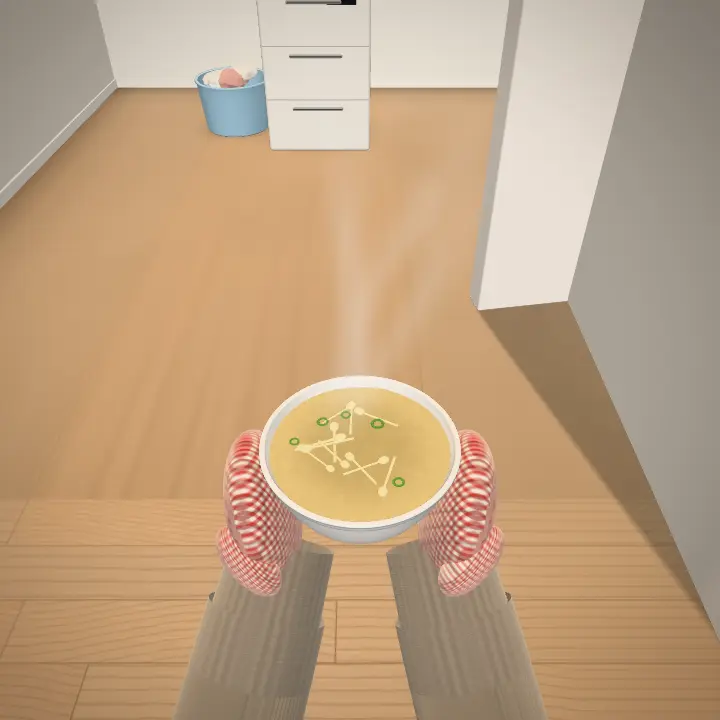
How to play
Pick up a bowl of soup filled to the brim at the stove and walk it to the table at the end of the route. You see the tray, the bowl and the floor ahead in first-person 3D. On a phone you use your finger; on a computer the mouse or the keyboard.
- Press Start and the game fills the screen while you lift the bowl. The × at the top right (Esc on a computer, Back on a phone) ends the round with no score.
- Walk: hold the screen to walk at a normal pace. Drag up from where you pressed to speed up and down to slow down; drag all the way down to stand still.
- Stop: letting go stops you on the spot. That is a hard stop and the soup surges forward, so it is safer to drag down and slow gradually.
- Tilt: drag left or right to tilt the bowl (or tray) that way. Tilting slightly against the slosh helps in corners and when something bumps you. On a phone you can switch on Tilt with phone (an iPhone asks for permission).
- Keyboard: hold ↑ (W) to walk, add Shift to go faster, ↓ (S) to slow down, ← → (A, D) to tilt. Releasing ↑ is a hard stop.
- Stop on the rug in front of the table and the bowl goes onto the table; the view then shows the soup left in the bowl and the drops on the floor behind you. Walk into the table and it spills big.
- The Slosh bar shows how much of the gap to the rim the surface is using. It spills when the bar reaches the red part. The short mark is the closest call of the round.
How the score works
The score is out of 100, to one decimal place. A 100 means not a single drop spilled and the bowl set down within par time.
- You start from the share of soup that arrives (%). Spilling 4 ml from a 400 ml bowl gives 99.
- Each drop on the floor costs 0.15. Spilled soup falls as drops and stays on the floor in the result view. On stages with a large tray, the tray catches small spills.
- Each second over par time costs 0.5. Par depends on the route length (about what you get walking at 0.42 m/s) and is shown in the top bar.
- After the round the spill is split by what pushed the soup at that moment (start, braking, the hard stop at the table, walking into the table, fast walking, sway, corner, tilt, sill, cat, brother, wet floor). The biggest cause is shown along with a recomputed score with only that habit fixed, for example “Stopped hard at the table and the soup surged forward → stopping 0.4 s earlier and slower would give 99.6”.
- The labels (Not a single drop; 98+ One wipe of the cloth; 95+ Soup map on the floor; 88+ Mom is not happy; 75+ Back with the mop; 50+ Soup became the side dish) are just for fun.
How the slosh is computed (game rules)
The soup is not simulated as particles. The game uses three low-order sloshing modes of a round container: the first antisymmetric mode, where the surface tips to one side (front-back and left-right components), and the first axisymmetric mode, where the middle rises and falls. Each mode behaves like a damped oscillator with its own natural frequency.
- The natural frequency comes from the standard formula for a cylindrical container, f = √(g·k·tanh(k·h)) / 2π with k = 1.841 / surface radius and h the depth. The game’s soup bowl is about 2.4 Hz, the brass bowl 2.1 Hz, the wide shallow bowl 1.3 Hz and the narrow soup mug 3.2 Hz.
- The bowl is pushed by the acceleration of starting and stopping, the front-back bob of your hands each step, the side sway every two steps, the centripetal acceleration in corners plus the swing of your hands as you turn, and your own tilt.
- Step frequency changes with speed (about 1.3 Hz at 0.4 m/s and 1.8 Hz at 1 m/s). The closer the step rhythm is to the bowl’s natural frequency, the more the slosh builds with each step. That is why a wide bowl can slosh more when you walk slowly.
- When the surface at the wall rises above the gap to the rim (2.3 to 7.5 mm when full), the excess flows over. Each soup has its own damping, and clear broths keep sloshing longer.
- The model runs in fixed 1/240 s steps and inputs are applied at the time your finger moved, so the same hand gives the same score even on a slow device.
Stage mode (10 stages)
Choose Stages above to see the stage grid. Each stage has its own bowls, route and obstacles, and you earn 0 to 3 stars from the score. Stage 1 is always open; any stage with at least 1 star unlocks the next. Stage records stay in this browser and are not ranked.
- 1. Three steps: a 2.4 m straight path. Just stop well.
- 2. Wide bowl: a wide, shallow bowl sloshes slowly, and slow steps can fall into its rhythm.
- 3. Soup mug: narrow and deep, it sloshes fast with only 2.5 mm to the rim.
- 4. Two on a tray: a large and a small bowl slosh at different rhythms, so one speed rarely suits both.
- 5. Cat crossing: the cat by the path crosses at the worst moment. Stop if you are about to step on it.
- 6. Door sill: step over it fast and your toe catches.
- 7. Wet floor: two wet spots. Cross them fast and you slip.
- 8. Corner: turn left to the table and tilt slightly inward.
- 9. Mom is calling: past 10.2 seconds you lose 5 points a second, and your brother runs in too.
- 10. Holiday table: three bowls on a tray, 8.4 m with a sill, a corner and the cat.
- Star thresholds are set so that a decent player gets 3 stars about four times in ten on stage 1, and mostly 1 or 2 stars after that.
Why liquid sloshes
Water or soup in a bowl tends to swing at a fixed rhythm. Nudge the bowl once and the surface rises on one side, then the other, again and again; that rhythm is the natural frequency. Wider bowls swing more slowly, narrower ones faster, and a shallow fill slows it down further.
- Resonance: when the bowl is shaken at a rhythm close to its natural frequency, each push adds a little more, like pushing a swing. When you walk, your hands move back and forth with every step and side to side every two steps, so your walking rhythm is what drives the bowl.
- The coffee study: a 2012 paper by Mayer and Krechetnikov in Physical Review E looked at people walking with coffee mugs, how the number of steps before spilling changes with walking speed and how full the mug is, and explained that the first sloshing frequency of a typical mug is close to the rhythm at which walking rocks it, which makes the slosh easy to build up.
- Water does not settle quickly: water and clear broth have little viscosity, so a slosh goes back and forth many times before it dies down. One hard stop can still matter a few steps later.
- The moment you stop: when you stop suddenly the bowl stops but the soup keeps going and climbs the front wall. Starting off does the opposite and the back rises. That is why spills so often happen right at the table.
- Tilting: if you tilt a bowl and hold it, the surface stays level with the world, so the lowered side of the rim comes closer to the surface. Tilt gently and only a little.
Tips for carrying a full bowl or cup
Common household advice. The game rewards the same ideas.
- Do not fill it to the brim: leaving even 1 cm makes a big difference. If it has to be full, top it up at the table.
- Start and stop slowly: the first and last steps are the riskiest. Slow down two or three steps before you stop.
- Keep a steady pace: speeding up and slowing down makes it worse. Take slightly shorter steps at an even speed.
- Two hands, close to the body: holding the bowl close with your elbows a little bent lets your arms absorb the bob and sway of walking.
- Use a tray: a damp cloth or a non-slip mat on the tray keeps the bowl from sliding, and the tray catches small spills. Put the bowl in the middle.
- Clear the way first: check for sills, wet patches, toys and pets, and wait a moment if children are running around.
Carrying hot soup
If the soup is hot, even a few drops can scald. Children have thinner skin and are hurt more easily.
- In a home with children, do not carry hot bowls at their head height; bring the soup once they are seated.
- Wipe up spills right away. A wet floor is how the next person slips.
- If hot soup gets on the skin, the usual advice is to cool it under cool running water (not ice water) for about 20 minutes. Get medical help for large blisters or burns over a wide area.
Today's soup and the leaderboard
Today's soup is set by this device's date, and the same date gives the same soup, bowl and route anywhere in the world. Routes are 4.6 to 6.6 m, about half of them have a corner, and one or two of the sill, cat, brother or wet floor show up. A new soup comes at midnight.
After setting down today's soup, enter a nickname under Submit below the result to post your score. Higher scores rank first; ties go to whoever posted first. The weekly board restarts every Monday at midnight Korea time, and the all-time board keeps growing.
- Score range: 0.1 to 100 (one decimal place).
- Timing check: no input is taken during the 0.8 s lift and the 0.9 s set-down, and walking speed has a cap, so even the shortest route cannot be rushed. The start token is used to confirm that at least 3.4 s really passed; each round can be posted once, within 15 minutes of starting.
- Practice soups and routes are random, saved only to your own history and never ranked.
- Nickname: 1–12 characters using Korean (Hangul), Latin letters (including Spanish á, ñ, ü), Japanese (kana/kanji), digits, spaces, _ or -. Profanity, slurs, names impersonating the site or its staff, and web addresses are not allowed.
- #number: the first time you submit, a random identifier is created in this browser and a four-digit number is derived from it, so you appear as Alex#4821. Players with the same name are told apart by the number, and changing your name in this browser also renames the scores you already submitted. Clearing browser data or submitting from another device or browser gives you a different number.
- Public, and removal: names, scores and dates on the leaderboard are visible to everyone. To prevent abuse we also store a one-way hash of your IP address, which is deleted after 30 days. To have an entry removed, contact us at the address in the privacy policy.
- You can submit up to 30 times per hour from the same connection. Scores found to be made by cheating may be removed.
FAQ
What is a good score?
There is no official standard. Walking with reasonable care usually lands between 95 and 99, and 100 needs no spill at all within par time. Letting go at the table for a hard stop is the most common way to miss by a hair.
Can I not just walk very slowly?
Slow is usually safer, but every second over par costs 0.5. A wide, shallow bowl also has a low natural frequency, so a slow walking rhythm can match it and make the slosh build. Each bowl has its own good speed.
I keep spilling right at the table.
Letting go stops you on the spot and the soup surges forward. Start dragging down two or three steps before the table and bring it to a stop on the rug.
When should I tilt?
In corners (the soup leans outward, so tilt inward) and when your brother clips you on the way past (tilt away from the push). Tilt too much and it spills over the lowered side.
When does today's soup change?
At midnight on this device's date. On the same date everyone gets the same soup and route. Practice is random every round.
How do I save the result image?
After a round, press Share result. You can post to Instagram Stories, Threads, X and more, or save the image, and make a short clip of the spill or the set-down. The clip is made on this device and is not uploaded anywhere.
Where is my history stored?
Your last 50 results, your best and your stage stars are stored only in this browser (localStorage) and are not sent to a server. Only scores you choose to submit to the leaderboard are stored on the server with your nickname and shown publicly.
The game is slow or not in 3D.
Browsers without WebGL2 get the same game in a flat 2D view. If it is slow, close other tabs and apps or try the latest Chrome, Safari, Edge or Firefox. The 3D view uses three.js (MIT license); the full text is in the license notice.
When does the weekly leaderboard reset?
Every Monday at 00:00 Korea time (Sunday 15:00 UTC). The all-time board never resets, and both boards show only the best score for each player (name#number).
Who can see my leaderboard entry, and can I remove it?
Your name, score and date are public, so do not use your real name or contact details as a nickname. Runs you do not submit are never sent to our server. To remove an entry, email us (see the privacy policy) with your name and number (for example Alex#4821) and the board.
What is the #number after my name?
A four-digit number that tells apart players who use the same name. The first time you submit, a random identifier is saved in this browser; our server only keeps a one-way hash of it and derives the number from that. The same browser gets the same number on the Korean, English and Japanese pages, and clearing browser data or using another device gives you a new one.
Something not working, or a feature you want? Send feedback