How to play
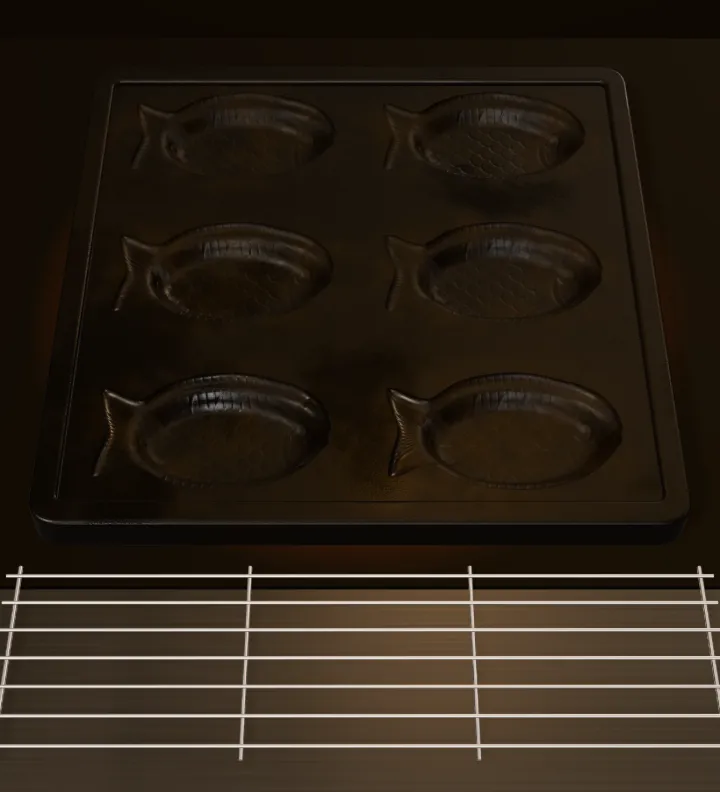
A street-stall cast-iron mold has six fish-shaped cavities. Press Start and the mold fills the screen for a 60-second round. Tap a cavity with your finger (or click it with a mouse) to move it to the next step. You can quit at any time with the × at the top right, the Esc key or your phone’s back button; a round you quit is not recorded.
- Pour the batter: tap an empty cavity. The side touching the iron starts cooking right away and the batter slowly puffs up.
- Add the filling: tap a cavity with batter to add red bean paste (or custard) and cover it with more batter. Use the Filling switch to choose; both score the same.
- Flip: the bar under each cavity shows how cooked the side facing the heat is. When the marker enters the yellow (golden) zone and the label turns yellow, tap to flip. Batter that has not set yet cannot be flipped.
- Take out: after the flip, the other side cooks. When the bar is yellow again, tap to take the pastry out. It goes onto the cooling rack in front, and the cavity is free for new batter.
- The round ends after 60 seconds; pastries still in the mold do not count. From the result on the board, Play again starts the next round right away, Share result saves or shares an image of your batch laid out on paper, and Close takes you back to the result panel on the page (history and leaderboard).
Scoring: golden 10 points, burnt −5
Each pastry is graded by how well both sides are cooked. One side takes about 5.6 seconds in an outer cavity and about 4.3 seconds in the middle row, right above the flame.
- Golden (10 points): both sides flipped and taken out inside the yellow zone.
- Okay (5 points): at least one side was a little light (just before the yellow zone) or a little dark (just after it).
- Undercooked (0 points): at least one side was taken out in the pale zone at the start of the bar. Pale outside, doughy inside.
- Burnt (−5 points): at least one side reached the black zone at the end of the bar. Ingredients wasted, and the cavity starts to smoke.
- Your score is the sum over all pastries taken out and never goes below 0. The theoretical maximum for one round is about 340 points (34 pastries).
- You cannot flip or take out batter that has not set (the very start of the bar), so tapping at random only makes undercooked pastries.
Tips for a big, even batch
Like a real stall, it is all about rhythm. One cavity makes a pastry about every 10 seconds, so the trick is to keep several cavities going a little out of step.
- Start with three or four cavities: if you pour all six at once, they all need flipping at the same moment and some will burn. Add more cavities once you get the rhythm.
- Stagger the pours: leave 1–2 seconds between cavities so the flips and take-outs are spread out too.
- The middle row cooks faster: the flame sits under the center of the mold, so the two middle cavities cook about 1.3 times faster than the front and back rows. Check them first.
- Refill right away: an emptied cavity accepts batter again after 0.3 seconds. The less time it stands empty, the more pastries you make.
- Add filling whenever: the filling step does not affect timing, so do it while you wait to flip.
- On a phone you can tap two different cavities with two fingers. Taps are accepted on a wide area around each cavity.
Stages (10 levels)
Choose Stages in the mode switch above to open the stage board. Each stage has its own griddle rules and time, and your score earns 0 to 3 stars. Stage 1 is always open; at least 1 star in a stage opens the next one. Stage results stay in this browser and are not ranked.
- Closed cavities and flame: a cavity under a lid cannot be used. When the heat differs between cavities, the bars in front of each label (1 to 3) show its flame, and a note appears when the flame moves.
- Order tickets: the current and next orders (bean and custard counts) sit in the lower left of the griddle. A fish with a filling neither order needs costs 5 points, so switch with the filling buttons below. The dot on each label is the filling inside.
- Customers in line: they only take golden fish. Each one still waiting when the round ends costs points.
- Zero burnt: the moment any cavity burns, the round ends and only the fish already taken out count.
- Star thresholds are set so a decent player gets 3 stars in stage 1 about four times in ten, and mostly 1 or 2 stars in later stages. After each round you see how many points the next star needs.
Bungeoppang and taiyaki
Bungeoppang is a Korean street snack: wheat batter with sweet red bean paste, cooked in a fish-shaped mold and sold at stalls from late autumn through winter. It is generally described as coming from Japanese taiyaki, arriving in Korea around the 1930s and taking the shape of a crucian carp (bungeo).
The tai in taiyaki is sea bream, a fish eaten on festive days in Japan. Taiyaki is widely said to have first been sold in Tokyo near the end of the Meiji era (the 1900s).
- Ingeoppang: a Korean cousin shaped like a carp, usually with thinner, crispier batter and more filling. Gukhwappang, shaped like a chrysanthemum, is another relative.
- Common fillings: chunky or smooth red bean paste and custard are the classics; sweet potato, pizza and chocolate versions also exist. In Japan, tsubuan (chunky), koshian (smooth) and custard are the most common.
- One fish per mold: some Japanese shops bake taiyaki one at a time in long-handled single molds. Fans jokingly call these "wild" (tennen) and the ones baked many to a plate "farmed" (yōshoku).
- Head or tail first? Which end to bite first is a classic conversation in both Korea and Japan. The tail has less filling and is crispier, so many people save it for last.
Why the edges get crispy and the middle stays soft
While batter still holds water, it stays at about 100 °C. Once the surface touching the iron dries out, it gets hotter, and the browning reaction between sugars and proteins (the Maillard reaction) plus caramelization of the sugar speed up, giving color and a toasty smell.
The thin rim of batter that squeezes out around the mold loses its water fastest, so it browns and crisps first. The middle, with the moist filling, stays soft. The game draws the thin edges and raised scales browning first for the same reason.
- Why cast iron: it stores a lot of heat, so pouring cold batter does not drop the temperature much and the surface cooks evenly. A well-oiled (seasoned) mold also keeps the batter from sticking.
- Where the flame is: stall molds are usually heated from below the center, so the middle cavities cook faster than the edges. Cooks rotate the mold or change the order to even it out.
- When to flip: too early and the runny batter loses its shape; too late and the bottom burns. Real cooks judge by the color of the rim, the smell and the steam.
Leaderboard: weekly and all-time rules
After a round, type a nickname under Leaderboard in the result panel to post your score. Higher scores rank higher; ties go to whoever posted first.
The weekly board restarts every Monday at 00:00 Korea time (Sunday 15:00 UTC), and the all-time board keeps growing. Each player (name#number) shows only their best score.
- Range: 1–480 points. A score of 0 cannot be posted.
- Checks: a round always lasts 60 seconds. A token issued when you press Start confirms that at least 59 seconds really passed. Each round can be posted once, within 15 minutes of starting.
- Devices: the rules are the same on every screen size, but fingers, mice and screen sizes can make it easier or harder. Treat the ranking as a bit of fun.
- Nickname: 1–12 characters using Korean (Hangul), Latin letters (including Spanish á, ñ, ü), Japanese (kana/kanji), digits, spaces, _ or -. Profanity, slurs, names impersonating the site or its staff, and web addresses are not allowed.
- #number: the first time you submit, a random identifier is created in this browser and a four-digit number is derived from it, so you appear as Alex#4821. Players with the same name are told apart by the number, and changing your name in this browser also renames the scores you already submitted. Clearing browser data or submitting from another device or browser gives you a different number.
- Public, and removal: names, scores and dates on the leaderboard are visible to everyone. To prevent abuse we also store a one-way hash of your IP address, which is deleted after 30 days. To have an entry removed, contact us at the address in the privacy policy.
- You can submit up to 30 times per hour from the same connection. Scores found to be made by cheating may be removed.
FAQ
What is a good score?
First rounds usually land around 50–100 points. Rotating three or four cavities out of step and getting nearly all of them golden passes 150, and keeping all six busy can go over 250. The theoretical maximum is about 340.
Does the middle row really cook faster?
Yes. The flame is treated as sitting under the center of the mold, so the two middle cavities cook about 1.3 times faster than the front and back rows. The bar under each cavity shows the actual doneness, so just follow the bar.
Does red bean or custard change the score?
No. The filling only changes how the pastry looks and the result image; cooking time and points are the same. You can switch in the middle of a round.
Can I play on a phone?
Yes. When you start, the mold fills the screen so the cavities are easy to tap, and you can tap two cavities with two fingers. The page does not scroll during a round; after you leave with the × or the back button it scrolls as usual.
How do I save the result image?
When the round ends, press Share result in the result panel. You can post it to an Instagram Story, Threads, X or WhatsApp, or save it as a PNG. The image shows this batch with the colors they actually came out.
Where is my history stored?
Your last 50 rounds and your best score are kept only in this browser (localStorage) and never sent to a server. Only scores you post to the leaderboard are stored on the server, with your nickname, and shown publicly.
The game is slow or the mold does not show up.
The game uses 3D graphics (WebGL2), which can be slow on older devices. Close other tabs and apps, or open it in a recent Chrome, Safari, Edge or Firefox. Browsers without WebGL2 get a flat top-down view of the same game. The 3D graphics use three.js (MIT License); see the license notice.
When does the weekly leaderboard reset?
Every Monday at 00:00 Korea time (Sunday 15:00 UTC). The all-time board never resets, and both boards show only the best score for each player (name#number).
Who can see my leaderboard entry, and can I remove it?
Your name, score and date are public, so do not use your real name or contact details as a nickname. Runs you do not submit are never sent to our server. To remove an entry, email us (see the privacy policy) with your name and number (for example Alex#4821) and the board.
What is the #number after my name?
A four-digit number that tells apart players who use the same name. The first time you submit, a random identifier is saved in this browser; our server only keeps a one-way hash of it and derives the number from that. The same browser gets the same number on the Korean, English and Japanese pages, and clearing browser data or using another device gives you a new one.
Something not working, or a feature you want? Send feedback