How to play
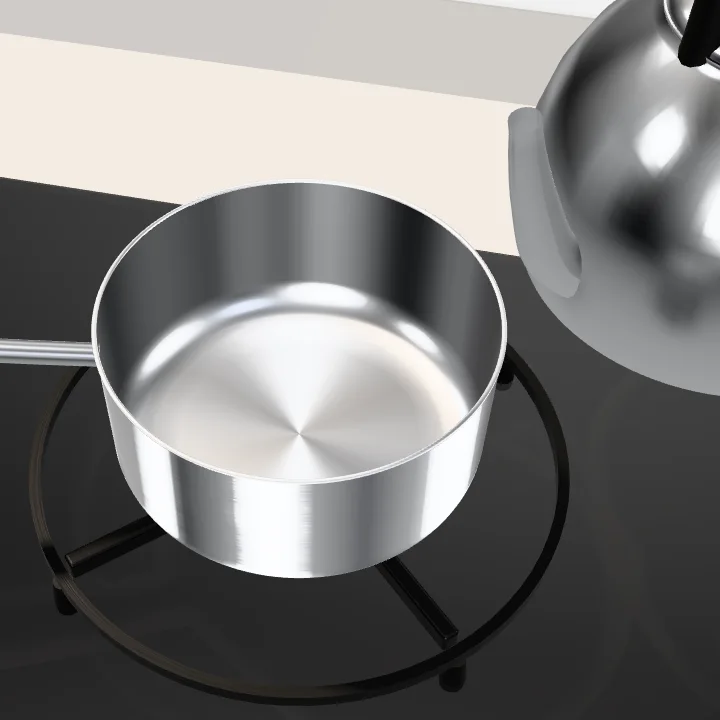
Pour water from a kettle into a pot that has no markings, and stop when you think it holds 2 cups (473 ml), the amount printed on most instant ramen packs in the US. Press Start and the game goes full screen with your first pot. Use your finger on a phone or the left mouse button on a computer.
- Press and hold to tilt the kettle and pour. Drag down while holding to tilt further and pour faster, drag back up to slow down, and let go to stop. On a computer you can also hold the space bar after selecting the board, and use ↓ and ↑ to change the tilt.
- You do not have to pour it all at once. Stop, look at the surface and add a little more. You cannot take water back out, though, and anything that overflows does not count.
- When you think it is 2 cups, press Done. A scale with a line every 50 ml appears on the inside wall from the bottom up, with the target as a red line, and the game shows the real amount and the difference (for example 486 ml · 13 ml over).
- The daily pots are three differently shaped pots (one wide, one tall and one other) in a row, and you can submit them to the leaderboard. In practice you pick one of six pots: a yellow aluminum pot, a milk pan, a shallow casserole, a saucepan, a stockpot or an enamel pot.
- The top bar shows the inside diameter and depth of each pot. The ramen block and seasoning packets on the counter are there for scale, too.
Score and ratings
For each pot the game measures the difference between the real amount and the target to the nearest milliliter, and your score is the total error of all three pots. Lower is better, and 0 ml is perfect. Too much and too little count the same.
- Example: 486 ml, 463 ml and 475 ml give 13 + 10 + 2 = a total error of 25 ml.
- Perfect zone: within ±5 ml of the target counts as perfect. When the scale appears it shows as a light red band around the target line, and the result tells you how far you were from perfect, how many millimeters that is at the surface, and how much earlier or later the last trickle should have stopped. The dashed gray line is where you stopped in this pot last time.
- Ratings for the daily pots: up to 20 ml is Ramen water pro, up to 50 ml Sharp eye, up to 100 ml Close enough, up to 200 ml A bit watery if you poured too much overall or A bit salty if too little, and beyond that Mostly water or Basically stir-fry. Practice (one pot) uses a third of these limits.
- The water in the kettle (0.85 to 1.75 liters) and the strength of the flow change a little for every pot, and the stream glugs when you tilt far. Pouring at the same angle for the same time gives very different amounts, so watching the surface works much better than counting seconds.
- The kettle does not straighten instantly when you let go, and the water in the air still lands. If you let go at a steep tilt, a few dozen milliliters more go in. Tilt less near the target.
Tips for reading the water level
The same 2 cups sit shallow in a wide pot and deep in a narrow one. In the 16 cm yellow pot they are about 2.6 cm deep, in the 14 cm milk pan about 3.1 cm, and in the 20 cm casserole only about 1.6 cm. Picture roughly how deep it should be from the size in the top bar before you start.
- Watch the far wall: the line where the water meets the wall is clearest on the far inside wall, near the top of the screen. Compare the distance from the rim down to that line with the depth. The near rim hides the water on your side.
- Do not trust the perspective: seen from above at an angle, the far wall looks shorter than it is. A pot that looks half full on screen is usually less than that.
- Wide pots are the hardest: in a 20 cm pot every millimeter of depth is about 30 ml. In a 14 cm milk pan it is about 15 ml.
- Think about the shape: in the enamel pot, which widens toward the top, the surface rises more slowly as it fills. In the saucepan with a rounded bottom, the first few millimeters fill fast.
- Watch the stream: a thicker stream means a faster pour. From about 80 to 90% of the target, switch to a thin stream, then stop, let the surface settle and top up.
Why the amount on the pack matters
The seasoning packet is a fixed amount, so the saltiness of the broth goes down as the water goes up. Using 2½ cups instead of 2 makes the broth about 20% weaker (2 ÷ 2.5), and 1½ cups makes it about 33% stronger (2 ÷ 1.5). A 100 ml miss in this game is a difference you would clearly taste in a real bowl.
Some water boils off while the noodles cook, and the noodles soak some up. A wide pot loses more because it has a larger surface, and so do a long boil or high heat. Measure what the pack says, and in a wide pot add just a little extra.
Packs differ. Most US-style 3 oz packs say 2 cups, while many Korean brands ask for 550 ml (about 2⅓ cups). Check the back of your pack.
How to measure 2 cups without a measuring cup
No measuring cup at home? Common things in the kitchen get you close.
- Water bottle: a standard 16.9 fl oz bottle holds 500 ml, so 2 cups is a full bottle minus a few sips (about 27 ml).
- Soda can: a 12 fl oz can holds 355 ml, so 2 cups is one can and a third.
- Kitchen scale: 1 ml of water weighs about 1 g. Put the pot on the scale, zero it and pour until it reads 473 g.
- Mug: mugs vary a lot (250 to 400 ml), so fill yours once with a measured bottle and remember where 2 cups reaches.
- Units: 1 US cup is 236.6 ml (8 fl oz). In many other countries a metric cup is 250 ml, and in Japan and Korea recipes use a 200 ml cup.
Stage mode (stages 1 to 10)
Choose Stages for a run of ten challenges that open one by one. Each stage has its own pot, target and twist, and your error earns 0 to 3 stars. One star opens the next stage, and your stars and best result for each stage are saved in this browser. Stages are not ranked.
The 8 spoons in the jjajang stage count a spoonful as 10 ml, so the target is 80 ml (about ⅓ cup). Real spoons hold more or less, so 8 spoonfuls can be anywhere from 60 to 120 ml.
- Stage 1, One pack: 2 cups in the yellow aluminum pot. 1, 2 and 3 stars at 40 / 18 / 10 ml error or less
- Stage 2, Thick noodles: 2 cups in the narrow, deep milk pan. 1, 2 and 3 stars at 30 / 12 / 3 ml error or less
- Stage 3, Two packs: 4 cups for two packs in the stockpot. 1, 2 and 3 stars at 50 / 15 / 3 ml error or less
- Stage 4, Don’t cross the line: Fill the cup exactly to the line inside. 1, 2 and 3 stars at 22 / 9 / 2 ml error or less
- Stage 5, Jjajang, 8 spoons: Pour 2½ cups, then drain until ⅓ cup (80 ml) is left. 1, 2 and 3 stars at 40 / 10 / 2 ml error or less
- Stage 6, Third coffee: Shaky hands, still 2 cups in the enamel pot. 1, 2 and 3 stars at 40 / 13 / 3 ml error or less
- Stage 7, Full kettle: 2 cups from a full kettle that gushes at first. 1, 2 and 3 stars at 35 / 11 / 2 ml error or less
- Stage 8, 5 seconds: 2 cups in the saucepan within 5 seconds. 1, 2 and 3 stars at 60 / 14 / 3 ml error or less
- Stage 9, Foggy glasses: 2 cups in the aluminum pot through the steam. 1, 2 and 3 stars at 45 / 15 / 3 ml error or less
- Stage 10, Three in a row: Three pots in a row, scored by total error. 1, 2 and 3 stars at 70 / 35 / 10 ml error or less
Daily pots and the leaderboard
The daily pots are set by the date on your device, and the English, Korean, Japanese and Spanish pages get the same three pots in the same order on the same day. The target follows instant ramen packs in each country: 2 cups (473 ml) in English, 550 ml in Korean and 500 ml in Japanese and Spanish.
After the third pot, you can enter a nickname under Leaderboard in the result panel. A lower total error ranks higher, and ties go to whoever submitted first. The weekly board restarts every Monday at 00:00 Korea time, and the all-time board keeps growing.
- Range: 0 to 999 ml, in whole milliliters. Practice cannot be submitted.
- Timing check: the kettle cannot pour faster than 200 ml per second, so a run can only be submitted after the minimum time it takes to pour the targets (about 6 seconds for a perfect run). Each run can be submitted once, within 15 minutes of starting.
- Devices: every screen shows the same pots from the same angle, but the water level is harder to read on a small screen. Take the ranking lightly.
- Nickname: 1–12 characters using Korean (Hangul), Latin letters (including Spanish á, ñ, ü), Japanese (kana/kanji), digits, spaces, _ or -. Profanity, slurs, names impersonating the site or its staff, and web addresses are not allowed.
- #number: the first time you submit, a random identifier is created in this browser and a four-digit number is derived from it, so you appear as Alex#4821. Players with the same name are told apart by the number, and changing your name in this browser also renames the scores you already submitted. Clearing browser data or submitting from another device or browser gives you a different number.
- Public, and removal: names, scores and dates on the leaderboard are visible to everyone. To prevent abuse we also store a one-way hash of your IP address, which is deleted after 30 days. To have an entry removed, contact us at the address in the privacy policy.
- You can submit up to 30 times per hour from the same connection. Scores found to be made by cheating may be removed.
FAQ
What is a good score?
A total of 50 ml or less over three pots means under about 17 ml per pot, a difference you would hardly taste in real ramen. 20 ml or less is rare. Days with the wide casserole tend to have bigger errors.
Can I just count seconds?
Not reliably. The amount of water in the kettle and the strength of the flow change for every pot, the flow drops as the kettle empties, and the stream glugs at a steep tilt. The same angle for the same time often misses by more than 100 ml, so watch the water.
Can I stop and pour more?
Yes. Until you press Done you can pour as many times as you like. You cannot remove water, though, so it is safer to pour a little under the target first and then top up.
How many milliliters are 2 cups?
2 US cups are 473 ml (16 fl oz). A metric cup is 250 ml, so 2 metric cups would be 500 ml. For instant ramen packs that say 2 cups, the small difference does not matter much.
The target is different in other languages. How is the leaderboard fair?
Each language uses the common instant ramen amount in that market (473 ml in English, 550 ml in Korean, 500 ml in Japanese and Spanish), and the leaderboard compares the error in milliliters. The three pots are the same in every language.
Does it work on a phone?
Yes. Press Start and the game fills the screen, and touching it there does not scroll the page. You can leave at any time with ×, the back button or Esc, and a run you leave early is not saved. A tablet or a computer screen makes the water a little easier to read.
How do I save the result image?
After the third pot, press Share result in the result panel. The image shows a photo of each pot with its revealed scale, the real amounts and your total error, and you can send it to Instagram Stories, Threads, X or a messaging app, or save it. On a computer it downloads as a PNG.
Where are my results stored?
Your last 50 results are saved only in this browser (localStorage) and are not sent to a server. Only results you submit to the leaderboard are stored on the server and shown publicly with your nickname.
The kitchen looks flat or the game is slow.
If your browser cannot use 3D graphics (WebGL2), you get a flat view drawn from the same angle that plays the same way. If it is slow, close other tabs and apps or try the latest Chrome, Safari, Edge or Firefox. The 3D view uses three.js (MIT License); see the license notice.
When does the weekly leaderboard reset?
Every Monday at 00:00 Korea time (Sunday 15:00 UTC). The all-time board never resets, and both boards show only the best score for each player (name#number).
Who can see my leaderboard entry, and can I remove it?
Your name, score and date are public, so do not use your real name or contact details as a nickname. Runs you do not submit are never sent to our server. To remove an entry, email us (see the privacy policy) with your name and number (for example Alex#4821) and the board.
What is the #number after my name?
A four-digit number that tells apart players who use the same name. The first time you submit, a random identifier is saved in this browser; our server only keeps a one-way hash of it and derives the number from that. The same browser gets the same number on the Korean, English and Japanese pages, and clearing browser data or using another device gives you a new one.
Something not working, or a feature you want? Send feedback