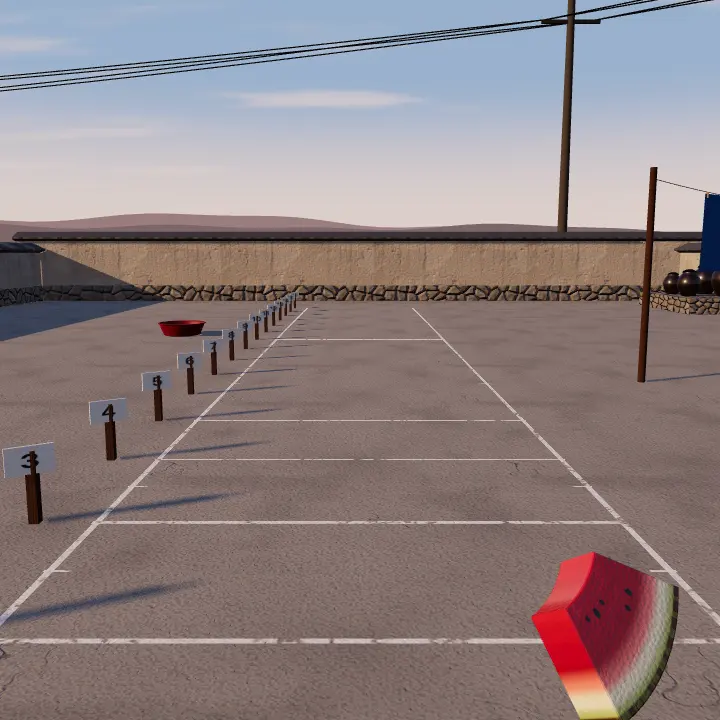
How to play
On a summer evening you sit on the edge of a wooden bench in a concrete yard, eating watermelon and spitting the seeds. On a phone use your finger; on a computer use the left mouse button (or the space bar and the up and down arrow keys). You get three spits, and the longest one is your score.
- Press Start on the board and the game fills the screen. The × at the top right (Esc on a computer, Back on a phone) ends the round without a score.
- Puff your cheeks: press and hold, and the pressure bar at the bottom fills, fast at first and then slower. The light green zone is good pressure, and the dark green mark inside it is exactly right.
- Set the angle: while holding, drag up to raise the angle and down to lower it. The protractor at the bottom left shows the number. On a computer the up and down arrows change it by 1° (5° with Shift).
- Spit: let go and the seed flies. The distance is measured where it finally stops after bouncing and sliding.
- If the pressure runs into the orange zone, power leaks out between your lips. In the red zone your lips burst and the seed drops on your foot (0 m). Hold for more than 2.6 seconds and you get the hiccups and swallow the seed (0 m). Spit almost straight up and the seed goes over your shoulder or lands on your head (0 m).
- When the seed stops, press again or wait a moment for the next spit. After three spits the result panel offers Play again, Share result and Close (the result panel on the page and the leaderboard).
Stage mode (10 stages)
Pick Stages in the mode buttons to open the stage grid. Each stage sets the seed, the wind, a target and how it is scored, and you get 0 to 3 stars for your score. Stage 1 is always open, and getting at least 1 star opens the next stage. Stage records are saved only in this browser and are not ranked.
Distance stages score the longest of your three spits (stage 9 scores the shortest), and target stages score the spit that ends up closest to the middle of the target (in cm, lower is better). The basin and the bowl count where the seed lands; the lines count where it stops. Distance stages show the next star as a flag, and the end panel tells you how far you were from the next star.
- 1. Past 5 m: no wind. The further, the more stars.
- 2. Red basin: land it in the basin at 6 m. Letting go before the green band makes it go shorter.
- 3. Headwind: 3 m/s from the front.
- 4. Crosswind basin: 2.5 m/s from the right and a basin at 6.5 m. Hold and drag sideways (← and → on a PC) to aim into the wind.
- 5. Slippery seed: slides well on the ground, but the perfect pressure band is narrow.
- 6. Tiny seed: a quarter of the weight of a normal seed, so the air slows it a lot. Light headwind.
- 7. Between the lines: stop it between the 9 m and 10 m lines. You have to judge the slide too.
- 8. The dog’s bowl: a small bowl at 7.5 m, a little to the right. Inside the bowl is 3 stars.
- 9. Three times 8 m: your shortest spit is the score. Light tailwind.
- 10. Gusty 12 m: the wind from behind rises and falls every 5 seconds and briefly turns into a headwind. Watch the wind speed at the top and spit in a strong gust.
- Star thresholds are set so that a fairly good player gets 3 stars in stage 1 about four times in ten, and mostly 1 or 2 stars in the later stages.
How distance is measured
Distance runs from the foul line in front of the bench to where the seed finally stops, measured straight down the lane (in meters, one decimal). It is the resting spot, not the first landing spot, just as in real seed spitting contests. There is a white line every meter, 50 cm ticks on the side lines and a numbered stake every meter on the left. A seed that ends up behind the line scores 0 m.
A round is three spits and the longest counts. The result comes from how long you held (pressure), the angle, today’s wind and today’s seed, so the same input always gives the same distance. Nothing is random.
Flags and colored lines in the yard show distances to beat: blue is your best today (in practice, your best for that setting), yellow is this week’s #1 on the leaderboard and pink is a score someone shared with you. After every spit the game tells you why it went that far and how far it would have gone with one change. At the end of a round it shows how far you were from today’s maximum, your best and this week’s #1.
The titles (Yard champion, The village head approves, The dog next door looked up, An ordinary summer, Edge of the bench, Needs a bib) are just for fun and are based on your share of today’s maximum distance. 97% or more makes you Yard champion.
Pressure, angle and the ground (game rules)
The game uses a few simple rules to decide how fast the seed leaves your mouth and what it does on the ground.
- Pressure and speed: cheek pressure rises quickly at first and then more slowly the longer you hold. Letting go at exactly the right pressure gives the top speed (11 m/s for a regular seed). Below that, speed drops with the square root of the pressure; above it, power leaks out and fades fast. Only right around the ideal pressure do your lips seal perfectly and add a little extra speed, so missing the dark green mark by 0.02 seconds can cost tens of centimeters.
- Angle: in the air alone, the farthest angle is close to 40°, but this game measures where the seed stops, so the slide along the ground counts too.
- Ground: if the flat seed comes down at a shallow angle (shallower than about 40°), it skips like a flat stone and slides across the concrete. If it comes down steeply, it stops almost where it lands. Spit too high and you lose on the ground; spit too low and you hit the ground early. The best angle lies in between, and going just a few degrees above it makes the distance drop sharply.
- Seed types: a regular seed weighs about 0.1 g. A small seed weighs about half that, so it leaves a little faster but loses speed sooner to air drag. A slippery seed slides farther on the ground, but it is slippery in your mouth too, so the ideal pressure window is narrower.
- Wind: seeds are light, so the wind matters a lot. A tailwind carries them farther, a headwind cuts the distance and a crosswind pushes them sideways (only the distance down the lane counts). The towels and undershirt on the clothesline on the right sway with the wind.
Tips for spitting farther
For the first few spits, watch only the pressure bar, then start changing the angle. The hints after each spit, such as “3° lower” or “0.05 s sooner”, show you where to go next.
- Pressure first: the moment you let go matters most. Release as the bar touches the dark green mark. The bar slows down as it fills, so there is no need to rush.
- Slide beats height: with no wind, a regular seed goes farther when spat low, around 15°, so that it slides along the ground, than in a high arc. A few degrees higher and it stops dead, so aiming 1 or 2° below the best angle is the safe choice.
- Read the wind: in a tailwind, spit a little higher to ride the wind longer; in a headwind, spit lower. A headwind tends to make the seed come down more steeply.
- Don’t hold it in: holding longer does not keep making it stronger. Once the bar reaches the red zone it is already too late.
- Repeat what works: the same input always gives the same result. Keep an angle that worked (the next round starts from it) and fine-tune only the moment you let go.
Real watermelon seed spitting contests
Seed spitting is a real contest at summer watermelon festivals. One of the best known is held at the Watermelon Thump in Luling, Texas. Contestants use seeds from melons cut on site, stay behind the line and get two tries on a long painted strip called the spitway; the longest spit wins. The distance is measured where the seed stops after bouncing or rolling, not where it first lands.
The record usually cited is 68 feet 9⅛ inches (about 20.96 m), spat by Lee Wheelis at the Luling festival in 1989. Good spitters are said to either spit high to ride the wind or spit low so the seed skips along the ground like a flat stone. Seed spitting contests (スイカの種飛ばし) are also held at summer festivals and watermelon-growing areas in Japan.
This game models an ordinary person spitting from a bench, so a good spit with no wind lands at around 10 to 12 m. Scores are capped at 20 m.
Projectile motion: why 30 to 45°?
Without air, an object thrown at a given speed goes farthest at 45°. When it lands at the height it was thrown from, the range is R = v² · sin(2θ) / g, and sin(2θ) is largest at θ = 45°. At 11 m/s that is about 12.3 m. Being a few degrees off barely matters: at 40° or 50° the range is only about 1.5% shorter.
Throwing from above the ground, as from your mouth, adds extra flight time on the way down, so the best angle becomes a little lower than 45°. Air drag lowers it further, because a higher throw stays in the air longer and loses more speed to drag. Drag matters more when an object catches a lot of air for its weight, that is, when it is light and flat. That is why a heavy shot put flies farthest at close to 40°, while light objects often do best in the 30s.
A watermelon seed weighs only about 0.1 g, so drag affects it strongly. In this game the farthest angle in the air alone is about 38° for a regular seed and about 35° for the lighter small seed. When distance is measured where the seed stops, as in real contests, the slide along the ground is added, and the best angle drops much lower.
About watermelons
The watermelon is the fruit of a vine in the gourd family and is believed to have originated in Africa. Its flesh is about 90% water, which makes it a good thirst quencher on hot days, and its red color comes from lycopene, the same pigment found in tomatoes.
Hard black seeds are mature seeds; the soft white ones in the same melon are immature. Seedless watermelons have three sets of chromosomes (they are triploid), so they cannot form proper seeds. They were first developed in Japan in the mid-20th century by the geneticist Hitoshi Kihara. The small white specks in a seedless watermelon are undeveloped seed coats.
Watermelon seeds are edible, and roasted watermelon seeds are a common snack in China and elsewhere. The old warning that a swallowed seed will grow a watermelon in your stomach is just a joke told to children.
Today’s wind and the leaderboard
Today’s wind and seed are set by this device’s date, so everyone on the same date gets the same ones, in any country. The wind blows from one of 16 directions at 0.2 to 2.8 m/s, and the regular, small and slippery seeds each appear once every three days in a shuffled order. They change at midnight.
After three spits in today’s wind, you can enter a nickname under Leaderboard in the results to post your distance. Longer is higher, and on a tie the earlier entry ranks higher. The weekly board restarts every Monday at 00:00 Korea time, and the all-time board keeps growing.
- Score range: 1 to 20 m (one decimal). Distances under 1 m cannot be posted.
- Timing check: using a code issued when the round starts, the server checks that enough time really passed during the three spits (0.9 s of waiting after each of the first two seeds stops, plus 0.015 s of cheek-filling per meter, plus the time to cover the distance at 14 m/s). Each round can be posted once, within 15 minutes of starting.
- Distances from Practice are saved only in your own history and are not ranked.
- Nickname: 1–12 characters using Korean (Hangul), Latin letters (including Spanish á, ñ, ü), Japanese (kana/kanji), digits, spaces, _ or -. Profanity, slurs, names impersonating the site or its staff, and web addresses are not allowed.
- #number: the first time you submit, a random identifier is created in this browser and a four-digit number is derived from it, so you appear as Alex#4821. Players with the same name are told apart by the number, and changing your name in this browser also renames the scores you already submitted. Clearing browser data or submitting from another device or browser gives you a different number.
- Public, and removal: names, scores and dates on the leaderboard are visible to everyone. To prevent abuse we also store a one-way hash of your IP address, which is deleted after 30 days. To have an entry removed, contact us at the address in the privacy policy.
- You can submit up to 30 times per hour from the same connection. Scores found to be made by cheating may be removed.
FAQ
What is a good distance?
There is no official standard. In this game a good spit with a regular seed and no wind lands at around 10 to 12 m. Beginners often get 7 to 9 m, and reaching 97% of today’s maximum makes you Yard champion. The result panel shows how far you were from today’s maximum.
Why did I get 0 m?
If the pressure runs into the red zone, your lips burst and the seed falls on your foot. Hold for more than 2.6 seconds and you get the hiccups and swallow the seed. Spit almost straight up and it goes over your shoulder or lands on your head. All of these score 0 m, and the hint after the spit tells you which one happened.
What angle is best?
It depends on the wind and the seed. In the air alone, close to 40° goes farthest, but this game measures where the seed stops, so a low spit that slides along the ground usually wins. With no wind, a regular seed goes farthest at a little over 15°, and a few degrees higher it stops instead of sliding. Follow the “° lower” hints after each spit.
Doesn’t holding longer make it stronger?
Only up to the ideal pressure. Hold longer and power leaks out between your lips, so the spit gets weaker, and in the red zone your lips burst. The dark green mark on the bar is the strongest point.
When does today’s wind change?
At midnight, when the date on this device changes. On the same date everyone gets the same wind and seed. In Practice you can choose the seed and the wind (none, headwind, tailwind, from the left or from the right, at 2 m/s) whenever you like.
Can I play on my phone?
Yes. Press, drag and release with one finger. After you press Start the game fills the screen so the page does not move, and the × or Back takes you back to the page. Portrait and landscape both work.
Can I turn the sound off?
Yes. The speaker button at the top left of the game view turns sound on and off, and your choice is saved in this browser. The sounds are generated in the browser, not recorded files, and only play after you press Start.
How do I save the result image?
At the end of a round, press Share result in the result panel. You can post it to an Instagram Story, Threads or X, send it in a messaging app, or save it as an image. It shows the three spots on the yard lane, the seed paths from the side, your distance and how far you were from the targets. Anyone who opens your link sees that distance as a flag in their yard.
Where is my history stored?
Your last 50 records, your best distance, today’s best, your last angle and the sound setting are stored only in this browser (localStorage) and are never sent to a server. Only distances you post to the leaderboard are stored on the server with your nickname and shown publicly.
The game is slow or does not show in 3D.
In browsers without 3D graphics (WebGL2), you play the same game in a flat side view. If it is slow, close other tabs and apps or try the latest Chrome, Safari, Edge or Firefox. The 3D graphics use three.js (MIT license); the full text is in the license notice.
How do stages unlock?
Stage 1 is open from the start, and getting at least 1 star in any stage opens the next one. Stars come from your best result in that stage, and stage records are saved only in this browser. Stage results are not ranked.
When does the weekly leaderboard reset?
Every Monday at 00:00 Korea time (Sunday 15:00 UTC). The all-time board never resets, and both boards show only the best score for each player (name#number).
Who can see my leaderboard entry, and can I remove it?
Your name, score and date are public, so do not use your real name or contact details as a nickname. Runs you do not submit are never sent to our server. To remove an entry, email us (see the privacy policy) with your name and number (for example Alex#4821) and the board.
What is the #number after my name?
A four-digit number that tells apart players who use the same name. The first time you submit, a random identifier is saved in this browser; our server only keeps a one-way hash of it and derives the number from that. The same browser gets the same number on the Korean, English and Japanese pages, and clearing browser data or using another device gives you a new one.
Something not working, or a feature you want? Send feedback