How to play
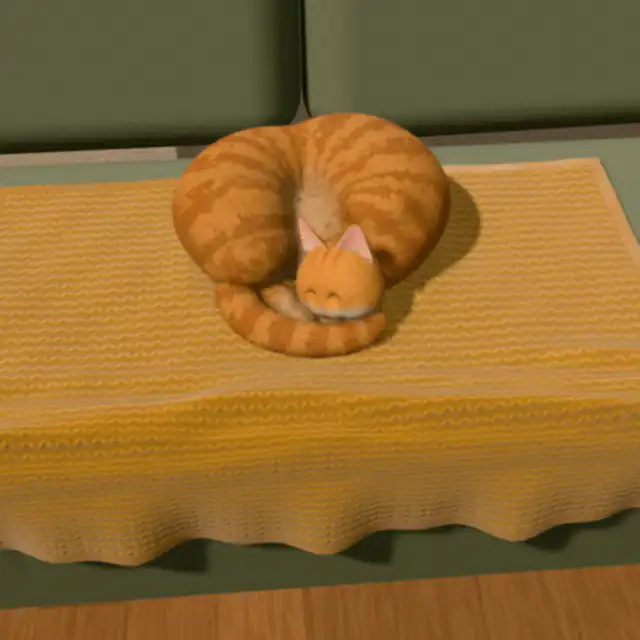
Use your finger on a phone, or hold the left mouse button and drag on a computer. A cat is curled up asleep on a blanket on the sofa cushion. Pull the blanket toward you until it is completely out, without waking the cat.
- Press Start on the board and the game fills the screen while the camera moves in on the cat. The × at the top right (Esc on a computer, Back on a phone) quits the round without a score.
- Grab: press the blanket edge in front of the cat (toward the bottom of the screen). The part under or behind the cat cannot be grabbed, and pressing the cat makes it twitch.
- Pull: keep pressing and drag down the screen; the blanket follows your hand. You can let go and grab again to pull in several strokes. The first stretch only straightens the loose, folded cloth, so the cat does not feel it.
- Cat reactions: as disturbance builds up, an ear flicks, the tail tip thumps, then the head lifts with half-open eyes. After that it wakes up, glares at you, and the round ends. Stop and wait, and the cat sinks back into deep sleep.
- Time: a time limit starts when you first grab the blanket. If it runs out before the blanket is out, the round ends.
- Sound: rustling cloth, a quiet purr while the cat is very deeply asleep, and a short sound when it lifts its head. The speaker button in the top bar turns it off or on, and the choice is saved in this browser.
- Get it all out and the result image shows the cat still asleep on the bare cushion with the blanket held up; wake it and you get the glare up close. Under the board, Play again starts a new round, Share result opens the share dialog, and Close goes to the result panel on the page.
How the score works
From 0 to 100, to one decimal place. The formula depends on how the round ends.
- Blanket out: 100 × calm − penalties. Calm comes from the most disturbed the cat got during the round; nothing is lost until well before an ear flick (below 12% disturbance). At most 8 points are lost this way.
- Cat woke up: 100 × share pulled out × 0.6 − penalties. Waking it in the last few centimeters still costs a lot.
- Out of time: 100 × share pulled out × calm − penalties.
- Penalties: −0.4 per ear flick, −0.8 per tail thump, −2 per head lift, −2 for touching the cat.
- The labels (The cat never knew at 100, Certified cat butler at 97+, Holding your breath paid off at 90+, The cat suspects something at 80+) are just for fun and set by this site. Careful players usually land in the low to mid 90s; 100 takes a pull so quiet that no ear ever moves, inside the time limit.
What wakes the cat (game rules)
Disturbance builds up while the blanket moves and drops while it is still. When the round ends, the main cause is shown.
- Speed: the faster the blanket moves, the faster the cat wakes. It grows with the square of the speed, so twice as fast builds up about four times as fast.
- Yanks: a sudden start or a burst of speed adds a large extra amount. Start and stop gently and this part is zero.
- Straight under the body: grabbing the edge in line with the cat pulls straight under it and is more sensitive. The further to the side you grab, the less it feels (about 60% at the far corners).
- No pauses: after about a second of continuous pulling, the cat gets more sensitive the longer you keep going. A short pause clears this quickly.
- Where the edge is: the cat barely feels the loose cloth straightening, and is dull while the blanket slides under its whole body. Once the edge reaches the body it gets more sensitive, peaking over the last 10 cm or so, where the edge passes under the belly and front paws.
- Sleep depth: each daily cat is in light, normal or deep sleep. Deeper sleepers are less sensitive and settle faster when you stop. After the cat has lifted its head once, it settles a little more slowly.
- Everything is computed from your finger movement and its timestamps, so the same hand gives the same score even on a slow device.
Stage mode (10 stages)
Choose Stages in the mode buttons above to open the stage board. Each stage has a set cat (sleep depth, size, spot and quirks) and blanket, and earns 0 to 3 stars based on the score (0–100). Stage 1 is always open, and each stage unlocks when you get at least 1 star in the one before it. Stage records stay in this browser and are not ranked.
- 1. Out cold: an ordinary cat in very deep sleep. A warm-up.
- 2. Light sleeper: more sensitive than usual and slower to settle again.
- 3. Blanket hog: the blanket runs 15 cm further behind the cat, so the pull is long. Pulling without pauses makes the cat touchier and touchier.
- 4. Big boned: 1.2 times the usual size, so both the pull and the touchy stretch under the belly are longer.
- 5. Deaf old-timer: barely notices speed (60% of usual) but feels every jolt when you start or stop. Start slowly and stop slowly.
- 6. Corner napper: the cat lies across one corner of the blanket. Grabbing in line with it is about twice as touchy; grabbing the far side of the edge is gentler.
- 7. Kitten: small, so the pull is short, but a little more sensitive to speed. It falls back asleep quickly when you stop.
- 8. Dreamer: every 2–5 seconds (3.6 on average) its paws and tail twitch for about a second. During a twitch it is more than three times as touchy, so stop. The time limit is longer to make up for it.
- 9. Running late: an ordinary cat, but only 10.5 seconds (usually about 12).
- 10. Chonk on fleece: a deeply asleep cat, 1.25 times the usual size, on a slippery fleece blanket. The blanket keeps sliding for a moment (about 0.7 s) after your hand stops, so stop early.
- Star thresholds are set so that a decent player gets 3 stars on stage 1 about four times in ten, and mostly 1–2 stars on later stages. Pulling the blanket all the way out usually earns 2 stars; waking the cat after getting more than 70% out still earns 1. After each round you see how many points the next star needs.
How much do cats sleep?
Adult cats are commonly said to sleep about 12 to 16 hours a day on average, and kittens and older cats sleep even more. Cats are most active around dawn and dusk, so they tend to sleep in long stretches during the day and at night.
Most of that is light dozing rather than deep sleep. Even while dozing, their ears turn toward sounds and they can wake at a small noise. Deep sleep comes in comparatively short stretches in between.
Light sleep vs. deep sleep
You can often tell from how the cat looks. The sleep depth in the game imitates these differences.
- Light sleep: often tucked up like a loaf with the head raised, or dozing with the eyes slightly open. The body is a little tense, and the ears swivel toward any sound.
- Deep sleep: the body goes completely limp, curled tight with the face tucked in or stretched out on its side. Whiskers, paws, ears or the tail tip may twitch, and the eyes may move under closed lids. The cat is harder to wake and may seem confused for a moment if woken suddenly.
- Occasional twitching during sleep is common. If the whole body stiffens and shakes, or the cat does not respond to you after the shaking stops, contact a veterinarian.
Why cats sleep on your blanket
When a cat settles on your blanket, the clothes you took off, or your laptop, these are the reasons usually given.
- Warmth: cats like warmer spots than people do. A fluffy blanket or a place you just got up from keeps body heat.
- Your familiar smell: the scent of the person they live with is reassuring.
- Leaving their own scent: cats have scent glands on the cheeks, chin and paw pads, so rubbing and kneading marks the spot as theirs.
- Soft and slightly raised: a soft spot a little above the floor is comfortable and good for keeping watch.
- Being near you: the sofa or bed is where they can be close to people.
How to move a sleeping cat kindly
In real life, do the opposite of this game. Suddenly pulling a blanket from under a sleeping cat can startle it into scratching or make it avoid that spot.
- Wait if you can: most cats get up and move on their own within a few hours.
- Let it know first: say its name softly or make a small sound nearby before touching it. Touching a sleeping cat out of nowhere is startling.
- If you lift it: put one hand under the chest behind the front legs and the other under the hind legs and rump, and hold it close to your body. Do not lift an adult cat by the scruff.
- Offer a replacement: a blanket of its own in the cat’s favorite spot often draws it away from yours. Some say the most reliable fix is simply buying a second blanket.
Daily cat and leaderboard
The daily cat is set by this device’s date, so everyone on the same date gets the same cat, in any country. The coat (tabby, ginger, tuxedo, calico), sleep depth, how much of the cat lies on the blanket, where and which way it lies, and the blanket pattern change every day, and the time limit is set to match. A new cat arrives at midnight.
After a daily round, enter a nickname under Leaderboard in the result panel to submit your score. Higher scores rank higher; ties go to whoever submitted first. The weekly board restarts every Monday at 00:00 Korea time, and the all-time board keeps growing. The end panel also shows how far you are from this week’s #1.
- Score range: 0.1 to 100 (one decimal).
- Timing check: input is ignored for the 0.9 seconds while the camera moves in. Pulling fast wakes the cat, so each point above 30 is assumed to take at least another 0.036 seconds, and the token issued at the start is used to check that this much time really passed. Each round can be submitted once, within 15 minutes of starting.
- Practice lets you pick the coat; everything else is random. It is saved to your own history only and is not ranked.
- Nickname: 1–12 characters using Korean (Hangul), Latin letters (including Spanish á, ñ, ü), Japanese (kana/kanji), digits, spaces, _ or -. Profanity, slurs, names impersonating the site or its staff, and web addresses are not allowed.
- #number: the first time you submit, a random identifier is created in this browser and a four-digit number is derived from it, so you appear as Alex#4821. Players with the same name are told apart by the number, and changing your name in this browser also renames the scores you already submitted. Clearing browser data or submitting from another device or browser gives you a different number.
- Public, and removal: names, scores and dates on the leaderboard are visible to everyone. To prevent abuse we also store a one-way hash of your IP address, which is deleted after 30 days. To have an entry removed, contact us at the address in the privacy policy.
- You can submit up to 30 times per hour from the same connection. Scores found to be made by cheating may be removed.
FAQ
What is a good score?
There is no official standard. If you stop when the cat reacts, finished rounds usually land in the low to mid 90s. Stop before an ear flicks and you pass 97; pull so quietly that no ear moves at all, inside the time limit, and you get 100.
It always wakes up at the very end.
The last 10 cm or so are where the blanket edge passes under the belly and front paws, the most sensitive part. Save your time for it. You can pull a bit faster while the loose cloth straightens and while the blanket slides under the whole body, then finish very slowly, pulling for about a second and pausing, over and over.
Where should I grab?
Only the blanket edge in front of the cat can be grabbed. Grabbing in line with the cat pulls straight under its body and is more sensitive, so grabbing off to the side helps.
Why is there a time limit?
Without one, pulling extremely slowly would give anyone 100. Each daily cat’s limit comes from how much blanket has to come out and how deeply it sleeps, and a quiet, efficient pull uses nearly all of it. It starts when you first grab the blanket.
Do cats really sleep all day?
Adult cats are commonly said to sleep about 12 to 16 hours a day, and kittens and older cats sleep more. Most of it is light dozing, though, so they wake easily at small noises.
My cat twitches while sleeping. Is that normal?
Twitching whiskers, paws or ears during deep sleep is common. If the whole body stiffens and shakes, or the cat does not respond after the shaking stops, contact a veterinarian.
How do I turn off the sound?
Press the speaker button at the right of the bar above the game. The setting is saved in this browser. Sound only plays after you press Start.
When does the daily cat change?
At midnight on this device. Everyone on the same date gets the same cat. In practice you choose the coat, and the cat’s position and sleep depth are random each round.
How do I save the result image?
When a round ends, press Share result. You can send it to an Instagram Story, Threads, X or a messaging app, or save it as an image. It shows the cat scene, your score and label, the gap to 100 and to your best, and the date.
Where are my scores stored?
Your last 50 scores, your best and the sound setting are stored only in this browser (localStorage) and are not sent anywhere. Only scores you submit to the leaderboard are stored on the server, with your nickname, and shown publicly.
It is slow, or I do not see 3D.
Browsers without 3D graphics (WebGL2) get the same game as a flat top-down drawing. On phones the fur is drawn with fewer layers, and the resolution drops a little if the device slows down. The 3D graphics use three.js (MIT license); the full text is in the license notice.
When does the weekly leaderboard reset?
Every Monday at 00:00 Korea time (Sunday 15:00 UTC). The all-time board never resets, and both boards show only the best score for each player (name#number).
Who can see my leaderboard entry, and can I remove it?
Your name, score and date are public, so do not use your real name or contact details as a nickname. Runs you do not submit are never sent to our server. To remove an entry, email us (see the privacy policy) with your name and number (for example Alex#4821) and the board.
What is the #number after my name?
A four-digit number that tells apart players who use the same name. The first time you submit, a random identifier is saved in this browser; our server only keeps a one-way hash of it and derives the number from that. The same browser gets the same number on the Korean, English and Japanese pages, and clearing browser data or using another device gives you a new one.
Something not working, or a feature you want? Send feedback