How to play
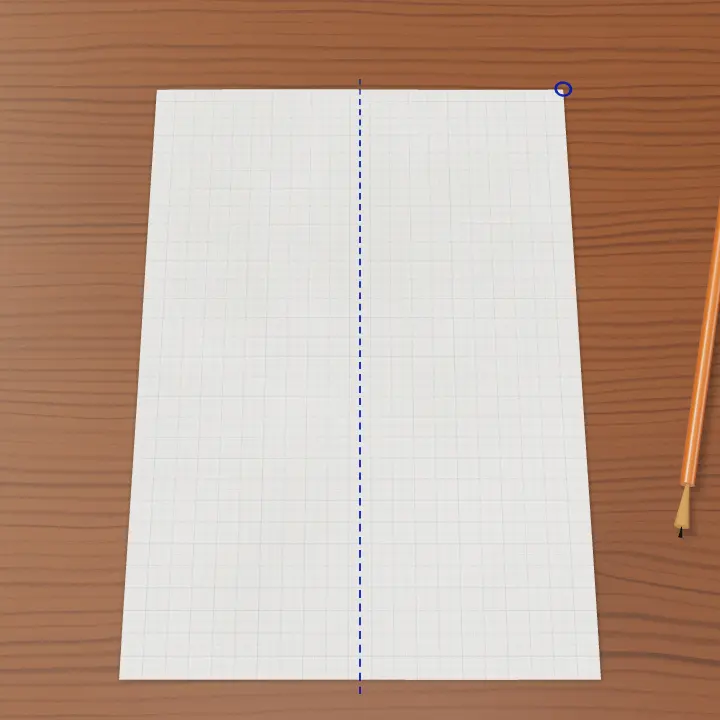
On a phone, use one finger. On a PC, hold the left mouse button and drag. You fold a sheet of paper on a desk into a classic dart, then throw that plane three times across a lawn at sunset.
- Press Start on the board and the game fills the screen. The × in the top right corner (Esc on a PC, Back on a phone) ends the round without a record and takes you back to the page.
- Eight folds: press the corner with the ring and drag it to the circle at the end of the dashed guide, then let go. The paper follows your finger and creases along the fold line when you release. A green circle means you are almost exactly on the mark. If you do not drag far enough, or stray far from the guide, the paper springs back.
- The order is: fold in half and open → both top corners to the center line → the new slanted edges to the center line again → fold in half along the center line → left wing → (the plane is turned over) right wing.
- When the last fold is done, the wings open and you see fold accuracy, balance, nose and dihedral, plus which way the plane will curve. Press Go throw.
- Throwing: hold the plane at the bottom of the screen, push up and let go. How fast your finger moves sets the strength, and how high you let go sets the angle (letting go at the horizon is level). The green part of the bar is the right strength; the red part is too hard.
- After three throws, the panel in the game offers Throw again (three more throws with the same plane right away), Fold new, Share result and Close (the result panel on the page and the leaderboard).
How distance is measured
Distance is measured from the start line to where the plane touches the ground, along the throwing direction (m, one decimal). White lines on the field mark every 5 m. If the plane curves to the side, only how far it went forward counts. Landing behind the start line counts as 0 m.
A round is three throws and the longest one is your record. The flight is calculated from the folded shape and the speed and angle of the throw, so the same plane thrown the same way always lands in the same place. Nothing in it depends on luck.
Flags and colored lines on the field show distances to beat: blue is your best today (in practice, the best for that setup), yellow is this week’s #1 on the leaderboard, and pink is a record someone shared with you. After every throw you see why it landed where it did and how far it would have gone with one change.
The labels on the result (Very far from 26 m, Far from 21 m, Flies well from 16 m) are just for fun and set by this site.
How the folded shape changes the flight (game rules)
The game measures the finished plane and sets its flight from that. For each fold, the error is the distance between where you let go and the target circle.
- Fold accuracy: 1 mm off the target gives 96%, 3 mm gives 74%, 5 mm gives 50%. Within 0.8 mm the paper lines up exactly. The fold in half follows the existing center crease, so it has no error.
- Balance: the game compares the area of the left and right wings, the angle each wing sits at, and how far the center of mass leans to one side. Any difference makes the plane bank to one side and curve that way. A large difference makes it spiral down.
- Nose: corners that miss the center line leave the nose blunt or crooked. A blunt nose adds drag and slows the plane quickly; a crooked one turns it slowly to that side.
- Dihedral: the angle at which the wing tips sit a little higher than the body. It brings a tilted plane back to level. A wing folded closer to the body than the guide is wider but droops; one folded farther out sits higher.
- Throwing: throw harder than the right strength and the paper bends, the nose rises and the plane loops or shoots up and falls. Throw too steeply and it loses speed and stalls. Too softly and it lands quickly.
Tips for a longer flight
A few millimeters in a fold and a few degrees in a throw decide meters of distance.
- Fold both sides the same: matching the left and right corners and the left and right wings matters most. One good side alone still makes the plane curve.
- Slightly above level: letting go just above the horizon (2 to 6°) goes farthest. Above 15° the plane tends to climb and stall.
- The right strength, not the most: let go while the bar is green. Red means a loop.
- Weight in the nose: a dart stacks several layers of paper at the front when the corners and edges are folded to the center. That weight keeps it stable, so fold the nose sharp and straight.
- Aim against the curve: if the fold result says the plane curves right, throw a little to the left. The “more to the left would have gone” hint after each throw tells you how much.
- Keep a good plane: a well folded plane can be thrown again and again with Throw again. Then only your throw needs work.
How a paper airplane flies
A paper airplane in flight is acted on by its weight, by lift from the wings pushing air downward, and by drag from the air it moves through. With no engine, the only forward push comes from your hand at the moment of the throw. After that it is a glider that slowly trades height and speed for distance. The more lift it makes for each unit of drag (the lift to drag ratio), the farther it goes from the same height.
The angle of attack is how far the nose points up relative to the oncoming air. More angle means more lift, up to a point where the airflow separates from the top of the wing and lift suddenly drops. That is a stall, and it is why a plane thrown too steeply hangs in the air and then falls.
When the center of gravity is ahead of the point where lift acts, a nose that rises is pushed back down by the lift, so the plane recovers on its own (pitch stability). That is why a dart with several layers in the nose flies straight, and why a plane that is too light at the front bobs up and down and drops.
With dihedral (wings raised slightly in a V), the lower wing makes more lift when the plane tilts, which rolls it back to level (roll stability). Wings that droop lose this, so once the plane tilts it keeps tilting.
How to fold a classic dart in real life
One sheet of A4 or letter paper is enough. Press each crease firmly with a fingernail or a ruler so the shape lasts.
- Lay the paper in portrait orientation, fold it in half lengthwise and unfold it to make a center crease.
- Fold the two top corners to the center line. The top becomes a pointed triangle like a roof.
- Fold the new slanted edges to the center line again. The nose gets sharper.
- Fold in half along the center crease. Both ways are common: with the folded flaps on the outside or on the inside.
- Fold the wings: fold one wing down so its slanted top edge lines up with the bottom edge of the body, then turn the plane over and fold the other wing the same way. Hold the wings together to check that they match.
- Open the wings so they sit roughly at right angles to the body and form a slight V when seen from the front.
- Test flight: if the nose dives, bend the back edges of both wings up a little. If it climbs and falls, bend them less or throw more softly. If it turns, check that both wings have the same shape and bend the back edge of the wing on the opposite side of the turn slightly up.
Paper airplane records
Guinness World Records keeps separate records for the farthest flight by a paper aircraft and for the longest time aloft. Record planes are designed for that purpose and thrown with full force, so they go much farther than an ordinary throw in a classroom or a park.
This game calculates an ordinary throw by hand from shoulder height, so with no wind a careful fold and a good throw land around 25 m. Throwing speed is capped at 16 m/s and records never exceed 40 m.
Today’s wind and the leaderboard
Today’s wind is set by this device’s date, so everyone on the same date gets the same wind and the same paper, wherever they are. The wind blows from one of 16 directions at 0.3 to 2.5 m/s, and A4 copy paper, lined notebook paper and graph paper each come up once in every three days, in a shuffled order. It changes at midnight.
After three throws in today’s wind, you can enter a nickname under Leaderboard in the result panel to submit your distance. Longer is higher; on a tie, the earlier submission ranks higher. The weekly board restarts every Monday at 00:00 Korea time, and the all-time board keeps growing.
- Range: 1 to 40 m (one decimal). Distances under 1 m cannot be submitted.
- Checks: with a token issued when the round starts, the server checks that enough real time has passed during the three throws (0.9 s × 2 of waiting after landing, plus the time to cover that distance at 18 m/s). Each round can be submitted once, within 15 minutes of starting.
- Distances thrown in Practice are saved only in your history, not on the leaderboard.
- Nickname: 1–12 characters using Korean (Hangul), Latin letters (including Spanish á, ñ, ü), Japanese (kana/kanji), digits, spaces, _ or -. Profanity, slurs, names impersonating the site or its staff, and web addresses are not allowed.
- #number: the first time you submit, a random identifier is created in this browser and a four-digit number is derived from it, so you appear as Alex#4821. Players with the same name are told apart by the number, and changing your name in this browser also renames the scores you already submitted. Clearing browser data or submitting from another device or browser gives you a different number.
- Public, and removal: names, scores and dates on the leaderboard are visible to everyone. To prevent abuse we also store a one-way hash of your IP address, which is deleted after 30 days. To have an entry removed, contact us at the address in the privacy policy.
- You can submit up to 30 times per hour from the same connection. Scores found to be made by cheating may be removed.
FAQ
What is a good distance?
There is no official standard. In this game, with no wind, folding both sides evenly and throwing slightly above level with the bar in the green lands around 25 m. At first 15 to 20 m is common, and going past 26 m needs both the folds and the throw to be almost exact.
Why does my plane curve to one side?
The left and right sides were folded slightly differently. The result shown after folding tells you which fold is how many millimeters off and which way the plane curves. Fold a new one and match that fold, or aim a little to the other side.
Doesn’t a harder throw go farther?
Up to a point. In this game, throwing in the red part of the bar (over about 13 m/s) bends the paper so the nose rises and the plane loops or shoots up and falls. The green part goes farthest.
Can I throw the same plane again?
Yes. After three throws, press Throw again in the result panel to throw the same plane three more times right away, with no folding. To start over from a flat sheet, press Fold new. Every three throws count as one round.
When does today’s wind change?
At midnight, when this device’s date changes. On the same date, everyone gets the same wind and paper. In Practice you can choose the paper and the wind (none, headwind, tailwind, from the left or from the right, at 2 m/s) at any time.
Can I play on a phone?
Yes. You fold and throw with one finger. Start makes the game fill the screen so the page does not move, and × or Back takes you back to the page. Both portrait and landscape work.
How do I save the result image?
When the round ends, press Share result in the result panel. You can post it to an Instagram story, Threads or X, send it in a messenger or save it as an image. The picture shows your folded plane, the three flight paths from above, the distance and the date, and anyone who opens your link sees that distance as a flag on their field.
Where is my history stored?
Your last 50 records, your best distance and today’s best are stored only in this browser (localStorage) and are not sent to a server. Only distances you submit to the leaderboard are stored on the server with your nickname and shown publicly.
The game is slow or not in 3D.
In browsers without 3D graphics (WebGL2), you play the same game in a flat view from above. If it is slow, close other tabs and apps or open it in the latest Chrome, Safari, Edge or Firefox. The 3D graphics use three.js (MIT License); see the license notice for the full text.
When does the weekly leaderboard reset?
Every Monday at 00:00 Korea time (Sunday 15:00 UTC). The all-time board never resets, and both boards show only the best score for each player (name#number).
Who can see my leaderboard entry, and can I remove it?
Your name, score and date are public, so do not use your real name or contact details as a nickname. Runs you do not submit are never sent to our server. To remove an entry, email us (see the privacy policy) with your name and number (for example Alex#4821) and the board.
What is the #number after my name?
A four-digit number that tells apart players who use the same name. The first time you submit, a random identifier is saved in this browser; our server only keeps a one-way hash of it and derives the number from that. The same browser gets the same number on the Korean, English and Japanese pages, and clearing browser data or using another device gives you a new one.
Something not working, or a feature you want? Send feedback